
The About Us page has become a competitive differentiator
If you have access to your website analytics – go take a look and see where your About Us page is on the most visited page list. If you’re like a lot of other small businesses, here's a scenario that plays out almost every time someone lands on your website. They browse your services, they like what they see, and then they do something almost every buyer does before making a buying decision - they click About Us.
And they find… a paragraph of corporate-speak written in the third person. Maybe a stock photo of a smiling stranger in a headset. No names. No faces. No story.
They leave.
Not because your prices were wrong. Not because your services didn't fit. But because they couldn't answer the most fundamental question a buyer needs to answer before spending money: Who are these people, and can I trust them?
People want to do business with other people. Whether you left your information off your about page in an attempt to look larger, to be less “mom and pop” or because you just didn’t think it mattered who you are – it’s time to revisit your about us page.
Why Your About Us Page Matters More Than Ever
We are living through an explosion of content. AI tools can generate blog posts, product descriptions, social media captions, and email sequences in seconds. The internet is filling up with polished, professional, completely soulless content produced at machine speed.
In this environment, the one thing that cannot be faked - the one thing that AI cannot generate for you - is your actual story and company culture.
Your team's faces. Your origin story. The charities you support every year. The inside jokes your staff has (even if they are mostly about you). The customer who changed the way you do business. These are things no algorithm can manufacture, and they are exactly what today's skeptical, information-saturated buyer is looking for.
The About Us page has become a competitive differentiator. Small businesses, in particular, have a massive advantage here. Small businesses have a human story that may resonate with their customers more than a larger, more impersonal brand. The question is whether you're using it.
What Should Actually Go On Your About Us Page?
Let's get practical. Here's what separates a forgettable About Us page from one that converts visitors into customers.
1: The Why
We’re not talking about your mission statement or even a list of credentials. Tell your full story.
Why did you start this business? Was there a moment of frustration that sparked it? A gap you saw in the market? A passion you couldn't ignore any longer? Did you leave a corporate job to do something you believed in? Did you build this while raising kids or working another job?
People connect to origin stories the way they connect to characters in a movie. When someone reads the real reason you started your business, they stop seeing a company and start seeing a person.
When it comes to authentic writing, my dad (who was a bit like Tom Skerritt in A River Runs Through It) always told me to write about what I know, and to write simply.
2. Real Photos of Real People
This cannot be overstated: limit the use of stock photos. We know this is hard to do especially when a lot of people are working remotely and scattered across the globe.
However, a stock photo of a "business team" does the opposite of what you intend. Rather than looking professional and legit, it signals to the viewer that there's no real team to show. It raises a subconscious red flag.
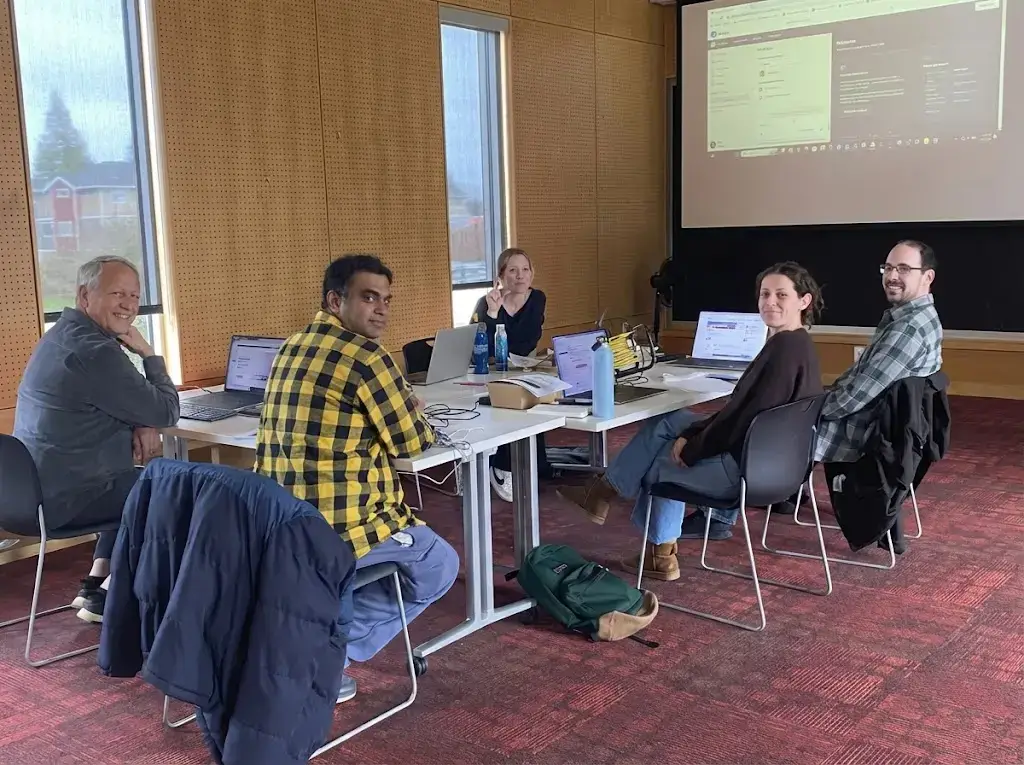
Real photos of real people will build trust. Even if the photos aren’t perfect, they will show a real team doing real work. We’ve even done a screen grab of a Zoom meeting before – you gotta do what you gotta do to show the real work being done at your company.
In fact, here’s most of our management crew at a recent in person meeting at the Ferndale Library. Peg snuck the photo – didn’t give us much time to pose or hide the cookie crumbs from Slice of Heaven Bakery.
What to include:
You don't need a professional photographer, though it helps. Honest, well-lit smartphone photos beat fake stock every single time.
3. Individual Team Bios With Personality
If you have a team, introduce them!
A great team bio answers: What does this person bring to the table, and what makes them a real human being?
That might include information about the person’s role with the company, when a customer might interact with that person, experience level, external hobbies, or anything that makes this employee light up when you ask about it.
Full bios also have an unexpected SEO benefit in that they add genuine, unique content to your site that search engines reward. If your business relies on local traffic, include what your employees like to do in your local area. Adding geographically
4. Your Mission and Values (In Plain Language)
What do you stand for? Why do you do what you do beyond making a living?
This doesn't need to be a formal document. It can be three or four sentences that explain what you believe about your industry, your customers, and the right way to do business.
For example:
"We believe small businesses deserve the same quality of marketing as the big guys. We're entrepreneurs who want to helps others grow and we think the best work comes from actually getting to know our clients."
That’s not a mission statement that has been over word-smithed or polished. If you can cross out your name, and add in someone else’s and the value proposition remains true, it’s time to rethink your mission.
5. Community Involvement and Charitable Work
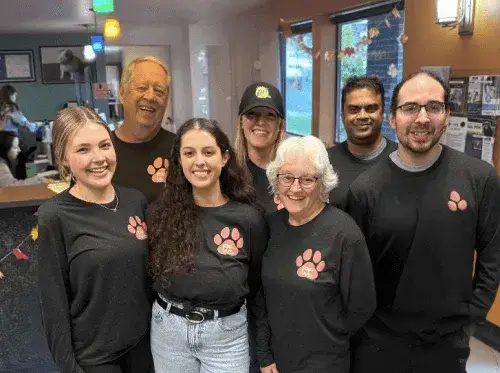
If your business supports a local cause, sponsors a youth sports team, donates to a food bank, or participates in community events (have you met team PawFusion from our Humane Society Fundraiser?) talk about it on your about us page!
This does several things at once:
Many small business owners do this kind of community work quietly, almost shyly. Don't be shy about it. It's one of the most powerful trust signals you can offer.
6. Customer Proof
Testimonials belong on your services pages, but your About Us page can include proof in a different, more personal form:
The goal here is to help your potential customer decide whether or not you are the right partner for them. Give them information on who you are with the bios, and let your work speak for itself with testimonials and customer proof.
7. A Clear, Low-Pressure Next Step
Your About Us page should end with an invitation, not a sales pitch.
Something as simple as: "We'd love to learn about your business. Reach out and let's have a conversation."
After reading your full story, visitors are primed to connect. Give them an easy, comfortable way to do it.
A Quick Checklist: Does Your About Us Page Have These?
If you're missing more than two or three of these, your About Us page should be tuned up so it can work for you!
Make it feel real!
Now that AI can generate really good content in no time, the businesses that win are the ones that feel real. Your About Us page is one of the most visited pages on your entire website, and it's the moment your potential customer decides whether they want to know more or move on to the next person.
You have a story. You have values and a community and a reason you show up every day. Tell that story, and you will stand out from 90% of the businesses in your space without spending a dollar on advertising. Though your next step with this would be to start sharing that story on Social Media too!
At ProFusion, helping small businesses tell that story is one of our favorite things to do. If you're not sure where or how to start, let’s chat!
Contact us for a free website review →
This content was written by Patrice Valentine. And yes, it took longer to write this than it would just to fire up Claude or ChatGPT, but that would be really hypocritical if I used AI to create an article telling people to be authentic in their content creation. Not all AI copy is bad, however. My next post will be talking about when and where to use AI copy.

Hi. I'm Patrice
Patrice has 20+ years of experience in business development, marketing, project management, and driving sales. Her exceptional interpersonal and creative problem-solving skills allow her to get to the heart of client problems and find effective solutions. She is well-known for her ability to relate to her customer problems and find effective solutions while providing exceptional leadership to ProFusion's project management, customer support and social marketing teams.